New research · published 28 September 2026
The customer’s next decision may happen before you see them.
We give research agents real-world customer missions, then examine the companies they consider, the information they use and the choices they make. The question: what happens to the customer relationship when software starts doing the research?
See what happenedExplore the original six-brand study
Research agents on consumer tasks, not customer traffic or a ranking of brands. Each story identifies its evidence and sample.
StudySeptember 2026 release
The original six-brand study
Amazon, Airbnb, Tesla, Costco, Temu and Ryanair: 27 journeys showing what the agent considered, selected and could not establish. This is a separate study from the findings above.
The Invisible FunnelTracking what happens when personal AI agents research, remember and decide before companies ever see the customer.
I gave an AI agent real buying decisions involving Amazon, Airbnb, Tesla, Costco, Temu and Ryanair. Then I watched which companies disappeared before the customer ever reached them.
Muse. Instinct. ChatGPT. Claude. Gemini. Your next customer may arrive through software that already knows what they want.
 0/6No Amazon-owned page accessedin 6 observed journeys
 0/4Not surfaced in the consideration setacross 4 observed journeys
 0/5No provider selectedin 5 observed journeys
 4/4help.ryanair.com refused the agentin 4 observed journeys
 4/4Selected without a Tesla-owned page readin 4 observed journeys
 4/4Selected; decisive facts from costco.comin 4 observed journeys
September 2026 brand release · Counts describe these journeys, not how often personal agents behave this way in the market. Every journey run on the live web. Every source, belief and decision published. Method →
The Invisible Funnel observes specific agent journeys. Results are not rankings of brand quality, customer experience or commercial performance, and should not be interpreted as representative of all agents, users or purchasing contexts.
Each observation is tied to a specific task, agent, date and information environment.
01Findings
What happened to each brand
Each story follows one customer mission on one brand, across every journey we ran. Open a story for its decision traces.
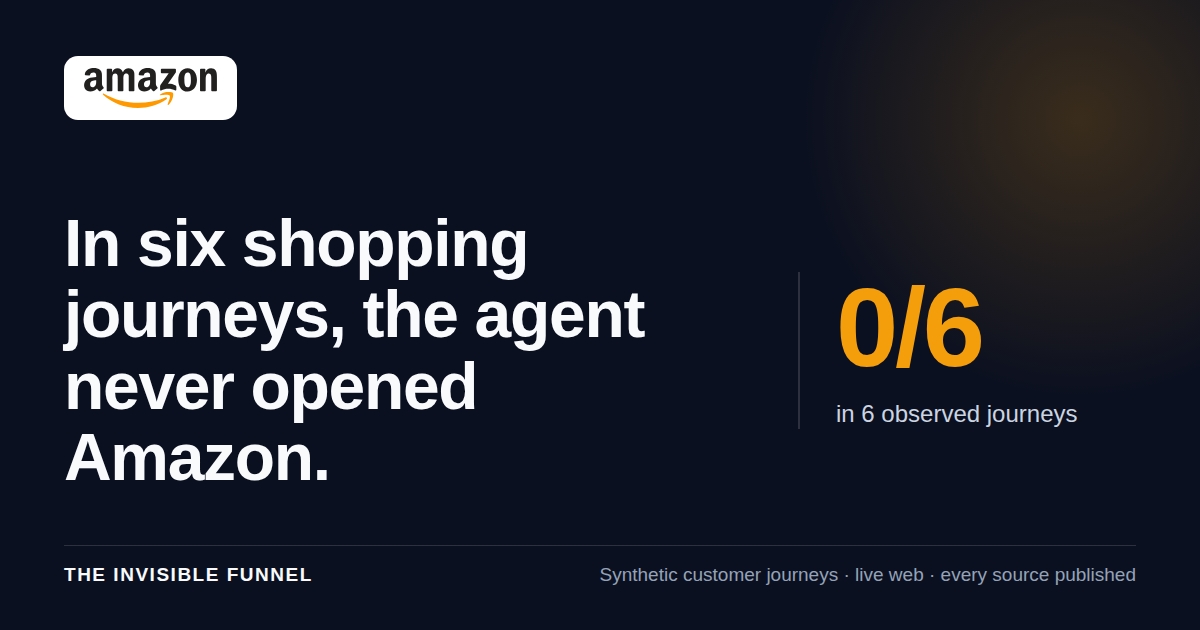
In six shopping journeys, the agent never opened Amazon.
Five journeys ended with no retailer recommended and one ran out of page reads; not one Amazon page was read.Open story and traces →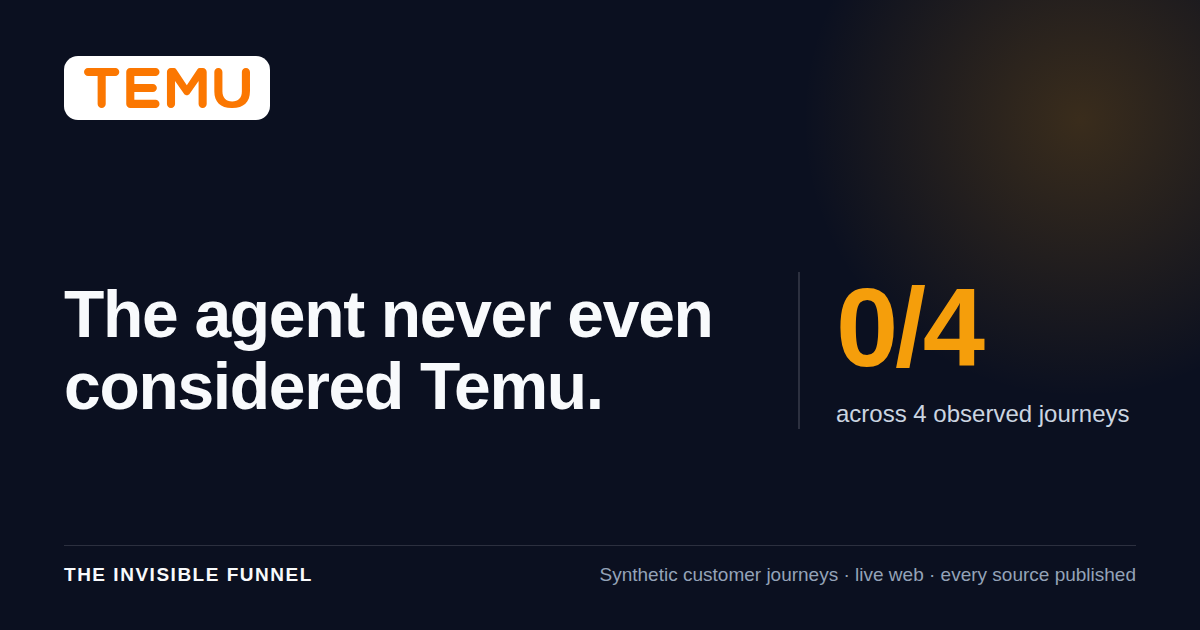
The agent never even considered Temu.
In four journeys Temu was not among the options the agent weighed and its site was never requested; no retailer was recommended.Open story and traces →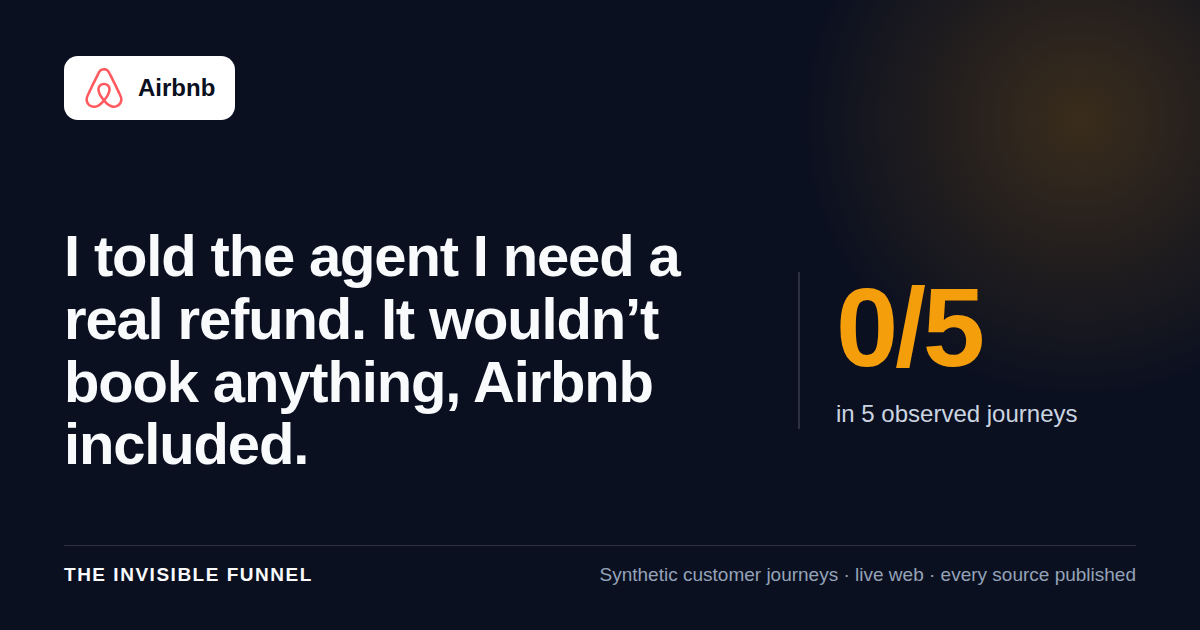
I told the agent I need a real refund. It wouldn’t book anything, Airbnb included.
In five journeys the agent recommended no accommodation: the seven-night total and the free-cancellation deadline could not be established from any provider’s own pages, Airbnb included.Open story and traces →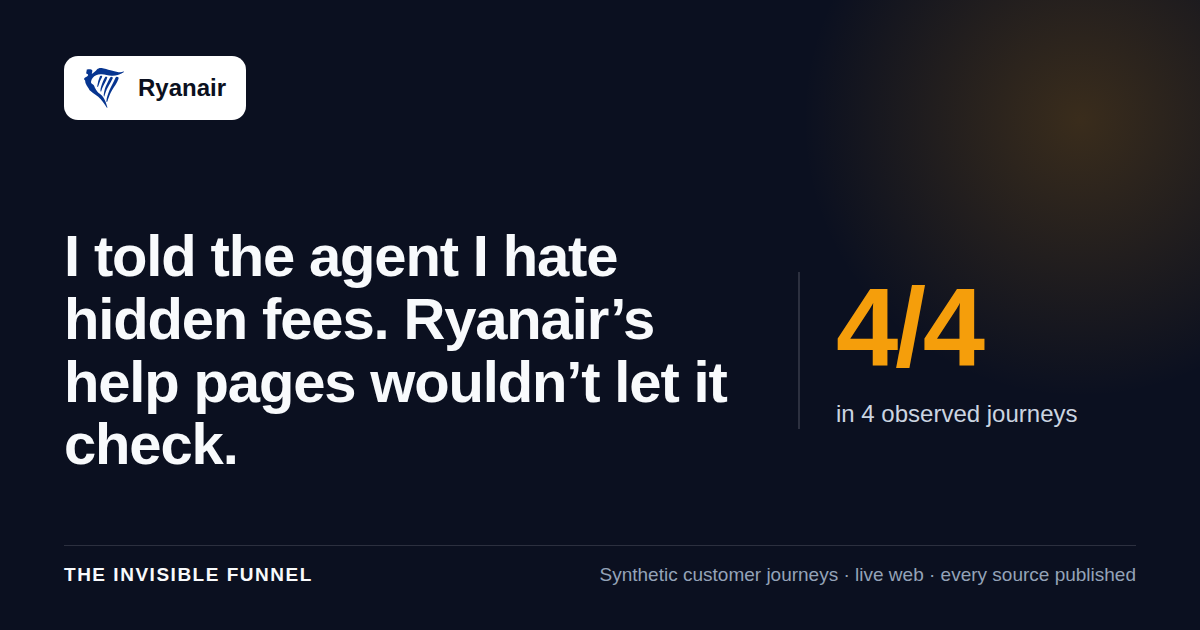
I told the agent I hate hidden fees. Ryanair’s help pages wouldn’t let it check.
In four journeys the agent recommended no airline: Ryanair’s help pages refused every request, and the all-in fare with bags, seats and airport check-in could not be established on any airline’s own pages.Open story and traces →
The agent chose Tesla without reading a single Tesla page.
Four journeys, four Model Y recommendations, zero readable Tesla pages: every fact came from Kelley Blue Book, Edmunds, search extracts and the Internet Archive.Open story and traces →
Costco passed the agent’s check: 4 out of 4, every fact from costco.com.
Four journeys, four recommendations for the Gold Star membership, every decisive fact read on Costco’s own pages in six to nine page reads.Open story and traces →→Implications
What this changes for brands and CX teams
The journey can start outside your channels.
A customer’s agent can narrow the options before your website or contact centre sees an interaction.
Your website is not the whole information environment.
Agents can assemble a view from comparison sites, other sources and information they already carry.
The relationship may arrive with a history.
Context from earlier decisions can travel with the customer’s software, rather than starting again with each company.
These observations do not tell us how large the shift will become. They make a practical question visible: what does it mean for the businesses and CX teams on the other side of the decision?
What would this mean for your customers?
If you work in a consumer business or customer operations, I’d welcome a conversation about what these observations mean in your market.
02Context
Why this matters
Customer experience has been organised around the enterprise operating the customer journey. Personal agents introduce a different architecture.
- Customera need, constraints, a historySynthetic in our journeys
- Personal agentintent · memory · preferences
research · comparison · decisionObserved27 journeys14 never reached the brand’s own site. - Enterprise boundaryaccess · identity · permissionReportedReported: Amazon restricted access by Meta’s MuseAn agent may choose a company; the company may decline to recognise the agent or let it act.
- Enterpriseoffer · commitment · execution · serviceNot yet observedNo journey on this site reached a transaction.
The customer’s agent decides whom to approach. The enterprise decides how that agent may engage.
Intent, preferences and memory can now travel with software the customer chose. That software can research a market, compare companies and decide which ones to engage before the enterprise sees the customer.
The enterprise remains authoritative for what it offers, what it will commit to, which agents it recognises and what those agents may do.
The products will change: Muse, Instinct, ChatGPT, Claude, Gemini and others. The structural question remains: what happens to customer experience when part of the relationship is operated from the customer side?
03Memory pilot · six-brand study
Same customer. Different memory.
Two synthetic customers, same task and requirements; one remembers a relevant past experience.
Limit. Two journeys per condition per brand, coded by keyword. This cannot establish that memory has no effect on the decision. A separate exploratory study with persistent notes: four agents kept notes; all four chose a local bank. Compare journeys →
04Data
The brand database
Every count from the September release, with its denominator. Open a brand for its journeys.
| Brand | Considered | Never considered | Selected | Not selected | No readable brand-owned page | Brand site refused | Mission | |
|---|---|---|---|---|---|---|---|---|
| AirbnbTravel | 4/580% | 1/520% | 0/50% | 4/580%no provider selected | 0/50% | 0/50% | Open-market searchOne-week stay for two with refund certainty required | › |
| AmazonE-commerce | 1/617% | 5/683% | 0/60% | 1/617%no provider selected | 6/6100% | 0/60% | Open-market searchCordless vacuum under $450, returns and delivery required | › |
| CostcoRetail | 4/4100% | 0/40% | 4/4100% | 0/40% | 0/40% | 0/40% | Named-offer checkGold Star membership conditions for a Denver household | › |
| RyanairTravel | 2/450% | 2/450% | 0/40% | 2/450%no provider selected | 0/40% | 4/4100% | Open-market searchDublin–Barcelona return, whole price before booking | › |
| TemuE-commerce | 0/40% | 4/4100% | 0/40% | 0/40% | 4/4100% | 0/40% | Open-market searchFive kitchen containers, delivery time and returns required | › |
| TeslaMobility | 4/4100% | 0/40% | 4/4100% | 0/40% | 4/4100% | 4/4100% | Named-offer checkModel Y under stated price, warranty and service constraints | › |
The brands were given different missions; the rows are not a ranking. Definitions of every column are on the Method page.